
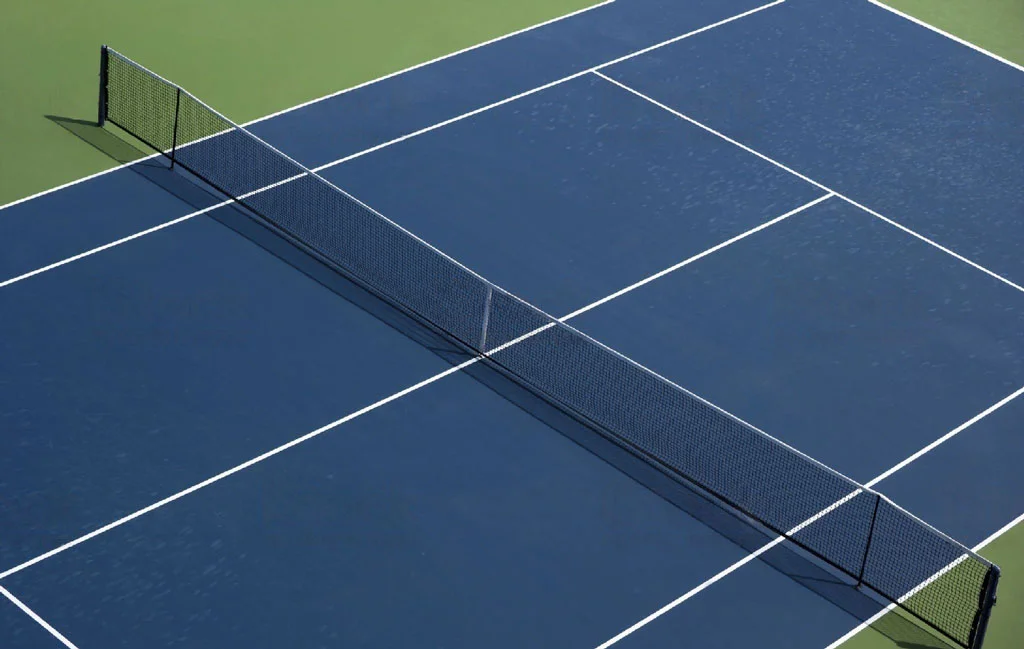

A standard tennis court has a fixed length for both singles and doubles matches, but the width changes depending on the format. Singles uses a narrower playing area, while doubles includes two additional side alleys that give players more room during rallies.
According to the International Tennis Federation (ITF), a tennis court measures 78 feet (23.77 metres) long. Its width is 27 feet (8.23 metres) for singles and 36 feet (10.97 metres) for doubles. Understanding these measurements helps players, coaches and facility owners identify the correct court layout.
Tennis Court Size: Official Dimensions for Singles and Doubles
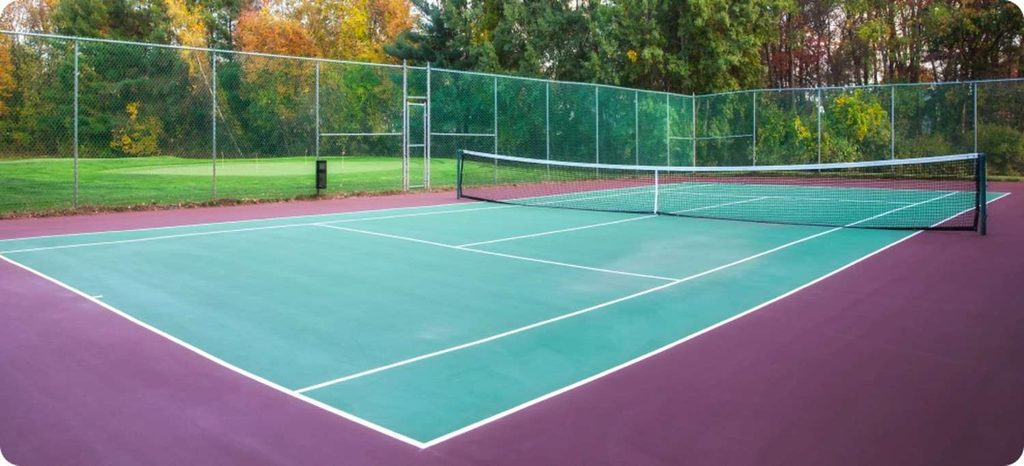
The official tennis court size is the same in length for singles and doubles. The difference is in the width and total playing area.
A singles court measures 78 feet by 27 feet, while a doubles court measures 78 feet by 36 feet. Most standard tennis facilities use the full doubles court layout, with inner sidelines marking the singles boundaries.
| Measurement | Singles Court | Doubles Court |
| Length | 78 ft (23.77 m) | 78 ft (23.77 m) |
| Width | 27 ft (8.23 m) | 36 ft (10.97 m) |
| Playing Area | 2,106 sq ft (195.7 m²) | 2,808 sq ft (260.9 m²) |
| Service Line Distance from Net | 21 ft (6.40 m) | 21 ft (6.40 m) |
The doubles court is 9 feet wider than the singles court. This additional width comes from a 4.5 foot alley on each side.
What Is the Size of a Singles Tennis Court?
A singles tennis court measures 78 feet long and 27 feet wide. Its playing area is 2,106 square feet, or approximately 195.7 square metres.
Singles matches involve one player on each side of the net. The narrower court means players must cover less width than they would in doubles. The inner sidelines mark the playing boundaries, so a ball landing outside these lines is considered out.
The service boxes remain the same size in singles and doubles. Players must serve diagonally into the opposite service box, and the doubles alleys are not included in the singles playing area.
What Is the Size of a Doubles Tennis Court?
A doubles tennis court measures 78 feet long and 36 feet wide. Its total playing area is 2,808 square feet, or approximately 260.9 square metres.
Doubles matches feature two players on each side of the net. The wider playing area gives teams more room to cover the court and coordinate their positions.
The outer sidelines define the doubles playing area. The additional strips between the singles and doubles sidelines are called doubles alleys. Each alley is 4.5 feet (1.37 metres) wide.
These alleys count as part of the playing area during doubles rallies. A ball landing inside an alley is in during doubles but out during singles.
Tennis Court Dimensions in Feet, Metres and Yards
Court measurements are commonly expressed in feet and metres. The following table covers the main dimensions used for court construction and match play.
| Court Feature | Feet | Metres |
| Court Length | 78 ft | 23.77 m |
| Singles Court Width | 27 ft | 8.23 m |
| Doubles Court Width | 36 ft | 10.97 m |
| Doubles Alley Width | 4.5 ft | 1.37 m |
| Service Line from Net | 21 ft | 6.40 m |
| Net Height at Centre | 3 ft | 0.914 m |
| Net Height at Posts | 3.5 ft | 1.07 m |
These measurements describe the playing surface. The surrounding clearance space is additional and should be considered separately when planning a tennis facility.
Tennis Court Markings and Their Dimensions
Every line on a tennis court has a specific purpose. The markings define the playing boundaries, service areas and positions used during a match.
1. Baseline
The baseline runs across the back of the court at each end. It marks the boundary behind which players serve and the limit of the playing area during rallies.
The distance between the two baselines is 78 feet. Each baseline also has a centre mark that helps players position themselves when serving.
2. Singles and Doubles Sidelines
The sidelines run along the length of the court. The inner sidelines define the singles playing area, while the outer sidelines define the doubles playing area.
The distance between the singles and doubles sidelines is 4.5 feet on each side. These additional strips form the doubles alleys.
3. Service Line
The service line runs parallel to the net on each side of the court. It is positioned 21 feet from the net.
During a serve, the ball must land inside the diagonally opposite service box. A serve landing beyond the service line is a fault.
4. Centre Service Line
The centre service line divides the service area into two equal boxes. It runs from the net to the service line and separates the deuce court from the advantage court.
Each service box measures approximately 13.5 feet wide and 21 feet long.
5. Doubles Alley
The doubles alley is the strip between the singles and doubles sidelines. It measures 4.5 feet wide on each side.
These alleys are used during doubles rallies but do not count as part of the singles playing area.
What Is the Standard Height of a Tennis Net?
The tennis net divides the court into two equal halves. Its height is different at the posts and the centre.
According to the ITF, the net measures 3.5 feet (1.07 metres) high at the posts and 3 feet (0.914 metres) at the centre. A white strap holds the net down at the middle to maintain the required height.
For doubles matches, the net posts are positioned 3 feet outside the doubles sidelines. In singles, singles sticks are used when a doubles net is in place.
How Much Space Is Needed to Build a Tennis Court?
The playing dimensions alone do not provide enough room to construct a usable tennis facility. Players need additional space beyond the baselines and sidelines to run, reach wide shots and move safely.
A commonly used tournament planning guideline recommends 21 feet (6.4 metres) of extra space beyond each baseline and 12 feet (3.66 metres) beyond each sideline.
For a full doubles court, this gives an overall recommended area of approximately 120 feet long and 60 feet wide. The total space is 7,200 square feet, or approximately 668.9 square metres.
| Space Requirement | Measurement |
| Doubles Playing Length | 78 ft |
| Doubles Playing Width | 36 ft |
| Clearance Beyond Each Baseline | 21 ft |
| Clearance Beyond Each Sideline | 12 ft |
| Recommended Overall Length | 120 ft |
| Recommended Overall Width | 60 ft |
| Total Recommended Area | 7,200 sq ft |
These measurements are planning guidelines for the surrounding space, not changes to the official playing dimensions. The actual area required can vary according to competition level, facility design and local construction standards.
Do Tennis Court Dimensions Change Depending on the Surface?
No. The official tennis court dimensions remain the same on grass, clay and hard courts. The ITF rules define the playing area, while the surface affects how the ball behaves during a match.
- Grass courts: The ball generally travels faster and stays lower after bouncing.
- Clay courts: The surface slows the ball and usually produces a higher bounce.
- Hard courts: These provide a more consistent bounce, although playing speed depends on the court’s construction and finish.
The choice of surface changes playing conditions, not the required length and width of a standard tennis court.
Conclusion
A standard tennis court is 78 feet long, with a width of 27 feet for singles and 36 feet for doubles. The additional 4.5 foot alley on each side creates the wider doubles playing area. The net, service lines and other markings also follow fixed ITF measurements. For court construction, allow additional clearance beyond the playing surface. A commonly used planning area is 120 feet by 60 feet, including the recommended run off space.
FAQs
A standard tennis court is 78 feet long. It is 27 feet wide for singles and 36 feet wide for doubles.
Yes. Both formats use the same court length, but a singles court is 27 feet wide while a doubles court is 36 feet wide.
The singles playing area is 2,106 square feet. The full doubles playing area measures 2,808 square feet.
A tennis net is 3.5 feet high at the posts and 3 feet high at the centre.
A commonly used planning guideline recommends an overall area of 120 feet by 60 feet for a doubles court, including 21 feet of clearance beyond each baseline and 12 feet beyond each sideline.